
.png)
I've known Jim for many years now, and he's the first person I call when I really need advice. I tend to bring him a tangle - half a business problem, half a personal one, no clear question. Jim listens to all of it and finds the thread I couldn't see.
And he'll tell you the truth. If you wait too long to act on that issue, it stops being an issue about the other person. It becomes yours. That was the most recent line he gave me, on something I'd been wrestling with. I haven't stopped thinking about it.
By any conventional measure, Jim is successful. He spent a decade as Chief Human Resources Officer at Rogers Communications, helping lead people and culture through significant change. He’s the author of Leading to Greatness, was named one of Canada’s 50 Best Executives by The Globe and Mail, and is a member of the Forbes Coaches Council.
But that's not what I admire most about him. What I admire most is that Jim has built a life that doesn't trade one part for another. The career, yes. But also his marriage to Pattie, the children he's raised, the grandchildren he shows up for, the friendships he's tended for decades. He's the person who'll send a quick text just to see how you're doing. And then there's the way people who've worked with him still talk about him, years later. His leadership advice is credible because he doesn't just teach it, he lives it.
This was the first time we'd sat down formally. I've been holding onto questions for years. What follows is part one of three.
What you'll learn
- The four-step sequence for building a winning team and why the second step is the one most leaders flinch from
- Why trust has to be built before you need it, and what happens to teams that try to build it mid-crisis
- The first thing Jim screens for when hiring — it isn't skills, and it isn't experience
- Why clarity —not effort — is the real path to great leadership
- Why the best leaders "eat last" — what Jim learned in the military that most executives never internalize
- The one question Jim now wants every leader asking in interviews
The interview
Q: After all these years watching top performers up close, what do the very best leaders do differently?
For thirty years I've studied what these executives do differently. One of the common themes I see around building teams is that they have really disciplined playbooks. These playbooks are not identical across all the people I've worked with, but there are some common elements to them.
The first thing is that these leaders see value in having the playbooks at all. If you think of them sitting in a leadership toolbox, you'll have one for how to hire the best people, one for building teams, one for culture, one for driving successful change. They're simple, actionable, and timeless.
In my early career I was a pilot. When you learn to fly to military standards, some of these things just become ingrained in you. In the top leaders, this playbook is ingrained in them. Over time, it's just a way that they operate.
The other thing I've learned, working with people like Jim Collins, is that these leaders come to understand the team is the critical performance unit in the company. Their success is tied to the strength of the team under them. Every action they take is around making sure the team under them gets stronger and stronger.
If you want a high-performance organization, one of the things you want to do is teach your leaders how to build great teams. The CEO's job isn't just to build one strong team — it's to make sure every leader in the company can do the same.
“The team is the critical performance unit in the company. Their success is tied to the strength of the team under them”
Q: What's actually in the playbook? What are the steps?
The first step, using Jim Collins' terminology from our research project Good to Great, is to get the right people on the bus.
Step two is to get the wrong people off the bus, which is just as important.
Step three is getting the right people into the right seats — in terms of talent and capability, in a way that is complementary to you as the leader.
Step four is building a high-performance team anchored in trust, where the team is focused and driven to deliver results.
Everyone wants a high-performing team but very few leaders have a focused plan for how to build one. It can start as a written playbook, a framework around what a high-performance team looks like. But over time, leaders become so competent that it becomes more mental.
Q: When you say "playbook," do you mean a literal document? A framework? Something in between?
It's not a document. It's a series of steps that, if you follow them, will get you a great result.
Think about a quarterback calling a play. Everybody on that play has a series of things they have to do to make the play work. The playbook is really a series of steps that drive toward an outcome.
For a leader, the playbook I coach people on is the four steps: right people on the bus, wrong people off the bus, right people in the right seats, strong team. What I'm trying to do through coaching is ingrain that in people's brains — so that when they think about people, those four steps are what they think about. If you deliver on that as a leader, half your job is done. You've set the stage for success, for yourself and for what your team has to deliver.
And it's discipline. The discipline to stay with the playbook, follow the playbook, commit to the playbook, live the playbook. What happens with most people is they get an idea, somebody shows them something, they try it once, and then they move on. That's not what disciplined leaders do. Disciplined leaders understand it, live it, and stay with it.
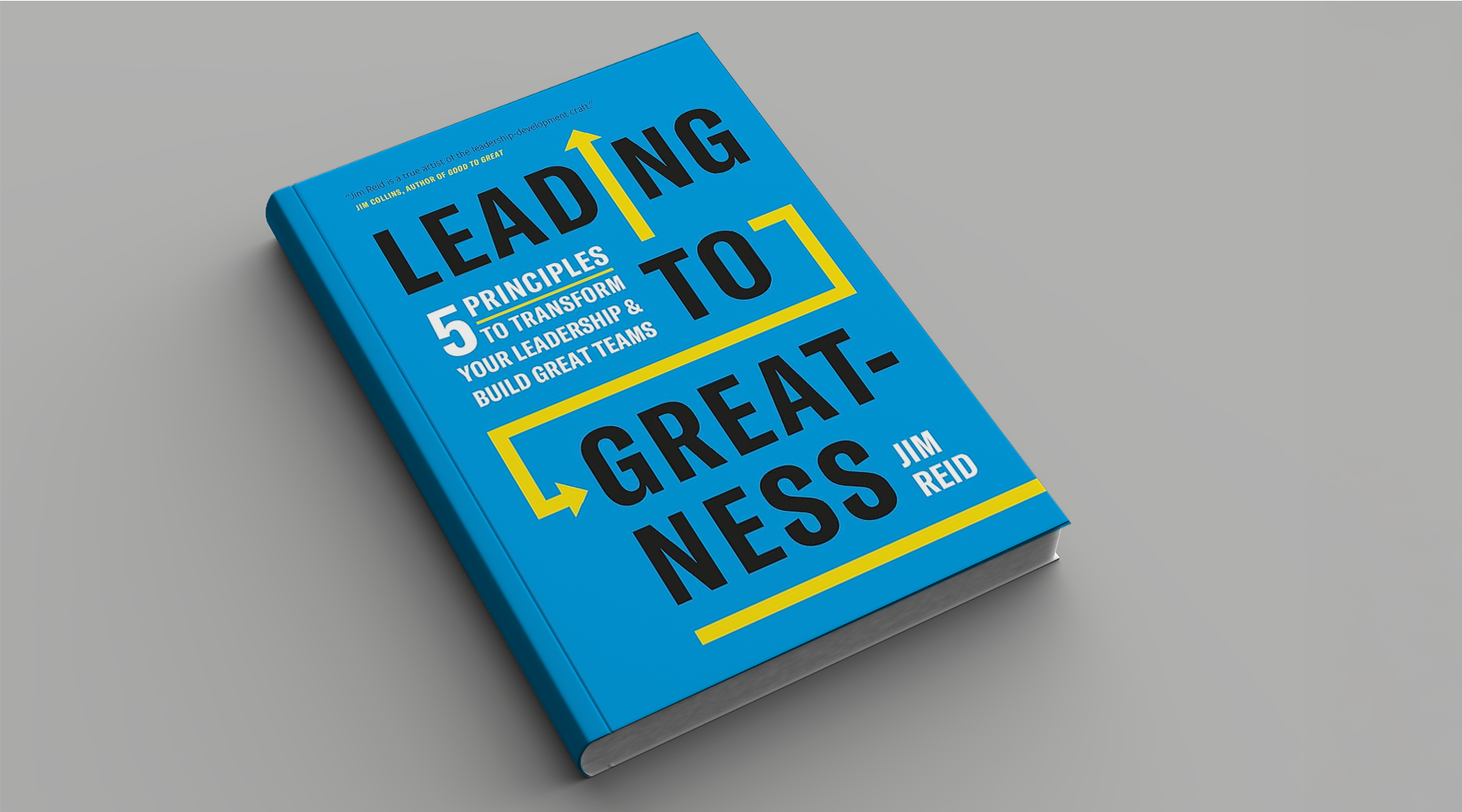
Q: Your book Leading to Greatness lays out five principles of leadership. What are they?
The five principles build on each other. The first three are foundational.
One: define and develop a crystal-clear understanding of your values and purpose — and never deviate.
Two: recognize your core strengths and align them with your passions.
Three: consistently make the right people decisions.
The last two are what take you from effective to exceptional.
Four: learn to manage energy, not time, so you can be fully engaged in life and leadership.
Five: develop a consistent inner discipline to achieve exceptional results.
These outstanding leaders are disciplined about all five.
Q: Is there one principle leaders tend to underestimate?
Having clarity. Clarity on your personal values and your passions. Clarity on your deep strengths — who you are and what you bring. In the world we live in, we can be good at a lot of things, but we can only be great at a few. That discovery process is being clear on what strengths you draw on for your best successes in life.
The same applies to how you hire. What does the right people mean to you? How do you deal with the wrong people?
A lack of clarity is a path to good. Crystal clarity is a path to great. People just aren't clear enough — they haven't done the work. I didn't start with this insight. I learned it by asking myself: what's the difference between this phenomenal executive and this average one? A lot of people understand what it takes, but they're not prepared to do what it takes. That's where the discipline and drive come in.
Q: When the stakes are high, what separates the teams that rise to the occasion from the ones that start to crack?
The first step is the right people on the bus, the wrong people off. When the stakes are high and the pressure is on, you have to look to your team to form around the challenge. Trust in each other, trust between the leader and the team — and not just trust, but psychological safety in the team environment.
If I was building a team to face an up-market or a down-market, I'd always say: trust must be built before you need it. It's very hard to build trust in the middle of a crisis. One of the requirements for trust is the right people. One wrong person on the team could suck the energy out of it faster than anything.
Trust is the oxygen for high performance. When trust isn't there, oxygen isn't there, and the team isn't going to rise to the challenge.
I use the five behaviours model around building a team. The foundation is trust. Element two is conflict and decision making. Element three is stronger commitment and clarity to the plan. Element four is accountability — both leader-to-team and peer-to-peer. All of that drives the fifth element, which is results.
It's another mental model the best leaders have in place. They don't keep it in a filing drawer. They're committed to it, they understand it, and they use it every day.
“Trust must be built before you need it. It’s very hard to build trust in the middle of a crisis”
Q: What does "the right people" really mean? And why do leaders so often hesitate when they know someone isn't the right fit?
The right people is all about fit. When you hire, your first screen is on fit with the team.
Do they share your values? Are they inspired by the purpose of the team? Are they excited by the work? Are they a team player? Is their ambition more centred on the team than on themselves? Are they willing to learn and grow? Do they have a strong work ethic? Are they willing to put in the effort when times are tough?
The way I think about it: I'm looking for high-quality fabric in the individual. It doesn't have to be the same fabric. I'm looking for high-quality silk, high-quality linen, high-quality cotton. The people on a great team don't have to be identical — they don't have to be the same kind of person. What binds them together is that they're all high-quality fabric.
Every leader needs to decide what fit means to them. The opposite is also true. The wrong people don't share the values. They're not inspired by the purpose. They're more driven to their own success than the team's. They're lazy. They don't step up. They're not open to change or to learning.
Hiring is first around fit — the right people. The second screen is whether they have the right skills and experience for the seat.
Screen one: the right people on the bus. Screen two: the right people in the right seats.
The reason fit is the first screen is that all the performance leverage for people is in how they behave and how they work with each other. When that's off the centre line in a culture, it's tough. It doesn't matter how much skill and experience you have if you can't work with others or if you don't fit the culture.
Leaders need to know how to probe values in an interview. Values are fundamental beliefs, and they drive behaviour. When values are off, they're very difficult to change. Hire in a way where the values are aligned, and you have confidence that the inside-out orientation of the person is right for you.
Q: What's the most common blind spot that holds leaders back from building a high-performing culture?
After thirty years of watching executives, the top three reasons they derail haven't really changed. Number one is failure to deliver. Number two is not getting along with their boss. Number three is not getting along with their peers. Number one is by far the biggest — and most of the time, when I trace it back, it points to a team change the leader waited too long to make.
Most CEOs would agree that if they could take a decision back to get better results, it almost always points to having waited too long to make a change on their team.
The longer a CEO waits to deal with an issue, the more they run the risk that it's no longer an individual performance issue — it becomes a leadership issue.
Waiting too long to get someone on your team to perform and deliver is one of the single biggest mistakes I see executives making. They have the instinct that they have to move on it, but they delay, delay, delay. There's a ramp-up time for hiring right, but that's a bit of a fallacy. The longer you wait, the deeper the performance hole is.
If you don't learn from your mistakes, you're going to repeat them. Performance starts to slip, leaders understand it's slipping because they have a couple of weak links on the team, and they delay dealing with it.
Q: You were a military pilot before moving into business. What did that teach you about leadership discipline?
I went through the Canadian military college system, trained as a pilot, spent five years in Germany, then came back as an instructor pilot flying tactical helicopters. I learned two things in the military: discipline and service to others.
There's a notion that leaders eat last — you put everyone before you. As a leader, that's a great responsibility.
The discipline gift from my military service has served me the best. It starts with clarity of the mission. What are you being asked to do? Are you clear on what's expected of you? When you're not clear, you seek clarity. You don't wait.
The second element of discipline is moving from understanding to action. For performance, you need to understand and act. The understanding needs to be deep, not surface level. You can understand how important a team is. The deeper level is understanding how to build a high-performance team.
Discipline is hard. Somebody can decide to eat healthier to get fit, but that requires behavior change. Leadership is a lot like that. It's not too hard to be good. It requires a lot of discipline to be great and to build a great team.
It's not about recognition of me as a leader. It's about the outcomes.
Q: For someone trying to get clearer on their own leadership — where to focus, how to build a stronger team — what's the practical starting point?
If you want to get better at something, pick a framework or playbook. Understand it and its limits. Put it into action. Stay with it. Leadership is about behaviour change.
If you want to think about strategy, pick a strategy framework that makes sense to you and do the work. The magic isn't as much in strategy as it is in execution. An average strategy with great execution will get you more than the opposite.
Q: With everything changing so fast — AI, economic pressure, the pace of disruption — do the foundational leadership principles still hold? Or do leaders need a different skill set today?
There's always going to be something changing in our world. AI is a good example today. Twenty years ago it was the Internet.
I frame it in two ways. If you want to be successful, what are the things that will not change in the human world — and how do you get great at those? And the stronger you get on the people leadership side of the house, the better able you are to deal with these new things like AI, or the next version of what's changing.
If you don't have great people, you won't be able to adapt.
The message for leaders is: get really great at the people side. When you have great people around you, they'll help you figure out every change. It's about mobilizing people around a challenge. You just have to get better and better at that.
If I knew then what I know now, I would have mastered some of these things much earlier in my career. I understand what drives results now. You can never have too strong a team under you.
Q: Has your definition of "the right people" shifted in the last few years — given how much AI is changing the work itself?
The fit screen hasn't really changed. The values, the work ethic, the team orientation, the willingness to learn — those still hold. If anything, that last one — the willingness to learn and grow, the not being afraid to change — has moved up the list.
Where it has shifted is on the second screen, the skills and experience side. There's a question I now want every leader to be asking in interviews: Give me a couple of examples of where you've used AI to drive a better outcome in your work. If a candidate can't answer that, for me, that's a flag. It tells you whether they're current — whether they're embracing new ways of doing things or staying away from them.
Jim Reid is an executive coach, board advisor, and author of Leading to Greatness. He spent a decade as Chief Human Resources Officer at Rogers Communications after an earlier career as a tactical helicopter pilot in the Canadian Armed Forces. He has worked alongside leading thinkers on organizational performance, including Jim Collins during the Good to Great research.
Part two of Learning From Jim Reid is coming soon.


